Showing posts with label monetization. Show all posts

Wednesday, December 17, 2008

Ads and Social Networking Sites Go Together Like Orange Juice and Toothpaste

Which is to say, people hate that combo. I came across a useful summary to that effect this morning:
Social Networking Sites and Advertising
Here's a summary for those of you who are too busy to, you know, read:
  • Consumers have a very low tolerance for online ads
  • 29.9% of visitors surveyed will immediately leave a site they see as cluttered with ads
  • Ads on social networking sites result in substantially fewer click-throughs, and even those who do click are less likely to make a purchase
  • Don't even think about charging customers for an ad-free site; they like that idea even less.
So what's to be done if you're running a social networking site? Frankly, there only appear to be three options (only one of which is good):
  1. Hope that your cash in the bank is enough to tide you over until advertisers are willing to pay a lot more for click-throughs (or until some marketing genius develops a much more clickable banner ad)
  2. Get really smart, really quickly, about contextually targeting your ad inventory to your visitors
  3. Forget about the idea of monetizing social networking, and figure out how to make that a side-project to your core business of selling something else
Overall, #3 has the best chance of success. At the very least, it's less dependent on brilliant flashes of insight; those things are great when you have them, but "we'll figure it out later" is a poor excuse for a business model (are you listening, Twitter?).

The bottom line in this scenario is not everything can be monetized. There are times in every person's life when you have your wallet out, and other times when you're simply not interested in spending money. Successful online businesses are likely to be the ones whose services most closely align with those "wallet-out" moments. Social networking sites are trying to swim against that tide, and will continue to do so as long as they're exclusively focused on social networking.

Looking into my crystal ball, here's what I forecast for Web 3.0: Facebook, MySpace, Twitter, Friendfeed, etc.: they will all go away (at least in their current forms). In their place will be a bunch of online businesses that incorporate social networking elements by default. Web 2.0 taught us how powerful the Web could be as a social mechanism, but it was a stop along the way, not a destination.

Monday, November 17, 2008

Coloring Facebook Green

This morning we've got two angles on Facebook's problem of making money. First, from the venerable Wall Street Journal, comes word of a new approach to ads on that social networking platform, namely "engagement ads":

The new ads appear on the main screen when a person first logs in to Facebook. They prompt a user to do something within the ad, such as comment on a movie trailer or RSVP for the season finale of a TV show.

If the user completes the action, such as adding Bravo TV's "Project Runway" show to a personal list of events, Facebook tries to get Bravo's ad in front of more eyeballs by sharing a notice about what the user has done with their friends.

This is clearly a step in the right direction. Engagement ads place the onus on the advertiser to find a marketing angle that is intrinsically social, and thus at home within the context of Facebook and other similar web destinations. Rather than simply putting ads in front of users and hoping for the best, these ads should, in theory at least, make the ads part of the social experience.

Still, they're asking a lot of their users. They're basically requesting that viewers opt-in to their marketing campaign, and you have to wonder what sort of adoption rate they're going to see. If they're advertising something cool and fun -- like the "Project Runway" episode -- I expect they'll get pretty good numbers. If, though, the payoff is lame ("Sign up here to get an exclusive MSN Messenger icon" or something like that) they can't expect many people to take them up on the offer, let alone do so in full knowledge that all their online friends will be pinged with the fact that they have done so.

Meanwhile, Facebook whiz kid Mark Zuckerburg is not concerned:
In public appearances, Facebook's 24-year-old Chief Executive Mark Zuckerberg insists that his company remains more focused on expanding its user base than its revenues. The right business model for the site will emerge over time, he has said.
So traffic is the new profits, after all.

On the other side of the coin, web development house Razorfish has weighed in with their Consumer Experience Report for 2008. (They've published the report in Flash, regrettably enough, but there is a PDF download link.) Things actually look pretty good for Facebook and other social platforms. In Razorfish's survey, three fourths of respondents said they didn't mind seeing ads on social networking services, and nearly half reported that they had purchased a product based on an online ad or the recommendation of an online social connection. On the face of it, this is hard to line up with the estimate in the WSJ article that less than 1% of Facebook's visitors click on an ad, but perhaps with that sort of destination -- where you tend to come back repeatedly, even obsessively, to fine-tune your profile and check on your friends' status -- sooner or later you'll end up clicking on one ad or another.

When it comes to engagement ads, of course only time will tell whether visitors will click on them enough to save Facebook's bacon. But for now they certainly seem to be a step in the right direction; if nothing else, engagement ads force marketers to try to think of ads that are actually engaging, rather than merely distracting.

Monday, August 18, 2008

Lehman's Has Got Your Back

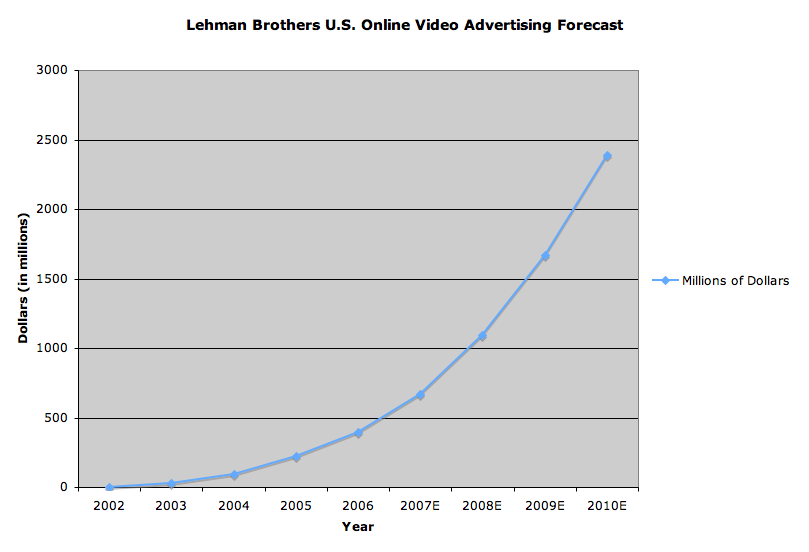
Reported on TechCrunch this morning, Lehman Brothers is forecasting a rosy future for web advertising: $20 billion in growth by 2012. Here's the graph, which is best viewed to the tune of "We're In the Money":

Of course, there's a bit of a catch -- Lehman's expects the hottest advertising category to be online video -- but even with that proviso, it's a welcome forecast for online content in general. I remember ten years ago, when we were all building content-rich sites in the confident expectation that ad revenues would grow quickly enough to justify what we were spending to do so. That didn't happen, of course, and a lot of us ended up on unemployment when the long-overdue market correction finally arrived. But advertising remains the great hope of web content, and growth along the lines of Lehman's forecast would go a long way towards justifying certain business plans.

My greatest fear is that, as the market expands, any advertising windfall will be so unequally distributed as to leave most Internet properties out in the cold. If online ad spend gushes into YouTube's, Hulio's, and Facebook's coffers, while the rest of us are left doing what we can with Google AdSense, then the overall market picture isn't going to be much better than it already is. And, somewhat pessimistically, I have to assume that will be the case, at least initially. Ultimately, of course, a rising tide lifts all boats; the question is whether that will happen quickly enough for your business and mine.

Tuesday, August 5, 2008

Can Twitter Ever Make Money?

There's an article this morning in Wired sounding a familiar theme: Twitter has decided that money is a problem for another day:

Twitter's Business Model? Well, Ummmm...
The article doesn't grab your attention from the outset. Yes, we know that Twitter will probably try to put ads on the service. Yes, we know that this risks pissing off users and driving them away. If you follow the Internet scene at all, you probably could have written that section of the article yourself.

Towards the close there are a few mildly interesting revenue possibilities. The first is to take a page from Google's book and ad contextual ads to a Twitter search function. No doubt the success of such a feature would depend on the volume of Twitter search, not to mention the likelihood that anyone would (to use the example from the article) go to Twitter (of all places) to search on "iPhone." Call me skeptical, but do iPhone customers not have better places to search for product information?

The second possibility is getting corporations to pay for access to their customers via Twitter. One problem here: first, you're asking companies to pay for something that everyone else gets for free. That might be a tough sell. I suspect, though, that the bigger difficulty is that corporate paid access would spoil the experience. I read blogs for baseball news. I know of a couple baseball blogs on local newspaper sites, written by trained reporters; I don't read them. I prefer amateur blogs because they are amateur: they provide unfiltered communication between fans of the game. Making it professional diminishes its appeal. The same could be true of Twitter: it's only cool to follow someone at Dell or General Motors if the tweets seem unofficial and off-the-cuff. Turn Twitter into a mechanism for traditional customer service, or -- worse -- corporate press releases, and it won't seem cool anymore.

The elephant in the room, of course, is the possibility that Twitter never will make money, because one of the things people like about it is that it's free and non-monetized. Whenever Twitter gets around to introducing ads into the mix, no doubt there will be several competing services that remain ad-free. If it turns out that money is antithetical to the spirit that drives web services like Twitter, the money game will be impossible to win.

Wednesday, July 23, 2008

Facebook Relying on the Money Fairies

Interesting interview with Sheryl Sandberg, Facebook's chief operating officer:

Facebook's Sandberg: Growth before monetization
Anyone who was working in the industry in 1998 or '99 should already be familiar with this sort of business plan:

"Our focus is on growth--we believe this is the moment people are joining social networks. Then it's monetization to support that growth."
In other words, do your thing, grow as fast as possible, and let the money take care of itself. Because that method worked so well for companies like Pets.com.

It's easy for me to sit here and point fingers. Monetizing web traffic has been a problem for as long as there's been web traffic, and finding a way to extract profit out of social interaction (without so tarnishing the experience that you drive your members away) is simply a tough nut to crack. To Facebook's credit, they seem to be focusing on advertising that promotes brand awareness, rather than direct product sales, and that's likely to be much less intrusive than most of the alternatives. Their goal should definitely be to avoid the hard-sell, "click here now!" approach that would quickly spoil the experience.

So, let's run down a few monetization possibilities for Facebook, and sites like it:
  1. The magazine model. Magazines and websites have a similar problem: they need to find a way to make money off of people who -- at the moment of engaging with their product -- are not interested in buying something. Magazines have long made a practice of putting glossy ads between their stories; no one spends much time on those ads, but advertisers still value the exposure and are willing to pay for it. Pro: a proven business model. Con: magazines also charge a subscription fee, and most people still think the web should be free.

  2. The drug dealer model (i.e. "the first taste is free"). Also known as the tiered service plan. Give away basic services, but charge for the premium plan. ESPN.com has been profitable for years with just this model. Pro: you don't need to convert everyone to a paying customer, just a sufficient percentage. Con: If a group of friends ends up with your pay wall dividing them, they're not going to enjoy the experience.

  3. The singles bar model. Invite people over to interact with each other, and sell something that, like booze, enhances the experience. Conceivably Facebook could develop a set of premium widgets that makes the Facebook experience more fun and rewarding. Pro: Similar to the tiered model, except you're not (necessarily) dividing your members into two camps. Con: one mojito tends to lead to another, but a customer is only going to buy your widget once.
Sites like Facebook and MySpace, of course, have a unique challenge: all their eggs are in the social networking basket, so they need to make that one activity profitable. For now, at least, the better business model might be to approach social networking as an adjunct to an already-profitable business model. If you already make a living selling cars or computers, and your primary goal is to increase customer satisfaction and brand loyalty, social networking is an excellent means of approaching that goal. If, however, social networking is the only product you have to offer, get thinking, because if there's one thing we learned in Y2K, it's that growth in and of itself is not a business plan.